This will be a short travelog as I didn’t keep up with either photography or note keeping during this week….but I do want to capture some of it so I don’t lose it in the future.
We drove from Scottsdale on Thursday and stopped in Winslow, Arizona for lunch….let’s see who can remember why that is famous (“Standing on a corner in Winslow, Arizona, such a fine sight to see…..” a song made famous by the Eagles). It is also famous as a railroad stop with one of Mary Elizabeth Jane Colter’s architectural feats: La Posada Hotel.

La Posada Hotel, the “last great railroad hotel,” was built in 1929 for the Santa Fe Railway, La Posada is truly one of America’s treasures.


The food was fantastic! I had churro lamb posole that was made from local sheep…Jack had tacos of the finest beef. They described the lamb: “Our native churro lamb is free range reared by Ron Garnanez of Shiprock. His flock spend the winters in the shaow of the rock and the summers grazing high in the Carrizo Mountains protected by dogs, llamas and guanacos.”
Yes, I too wondered about “guanacos.” They are a type of llama.
We drove on and headed east towards Albuquerque and then North to stay at Tamaya Resort…a beautiful Hyatt property on the Rio Grande River.
Next day, Jack’s birthday was celebrated all day! We drove to Santa Fe and went to the convention center where we had tickets for the Best of Show luncheon and award ceremony. The room was filled with artwork submitted by artists in all media (from film to pottery to beadwork to painting and photography to jewelry and weaving).
In all there were something like 13 major categories (and divisions within) for which awards were given. “Best of Class” was awarded to each of the 13 areas. Then, among those 13, one is typically chosen as “Best of Show.” This time, the judges could not decided and awarded two “Bests.”
What we liked best were the modest speeches that were made by the award winners. In particular, the last of the 13 was an elderly woman who won for beadwork.

She was a humble woman who accepted the award on behalf of her ancestors who were persecuted for doing “traditional” native artwork. She was passionate about preserving the traditional ways and her heritage. Her husband and grandson were in the audience and the show had a category for youngsters’ artwork and her grandson was among the artist shown: an example of her commitment to continuing this tradition. She had been coming to Indian Market for something like 30 years and never thought she would win. It was quite a moving speech.
After lunch we checked into our condo (timeshare) and relaxed a bit before returning for the “sneak preview” of the artwork. This time the convention center was even more crowded, and new artwork had been added. These two visits gave us a window into the hundreds (1200!) of artists we would see over the weekend. Many people scope out the items they want to buy at the “best of show” and then camp out near the artists’ booths early in the morning at the start of the show.

We saw our friend DY Begay who received a blue ribbon for the one piece of weaving she had to bring to the show. The sale of her piece first thing the next morning is an example of how the process works: the best goes fast!
We went from there for a birthday dinner at an amazing restaurant: Geronimo’s on Canyon Road. If our friend, Natalie Fitg-Gerald (who is friends with the owner) hadn’t made reservations for us last month, we would never have gotten in during Indian Market. We had a fabulous dinner of elk, shrimp, pear salad and crab cakes. Those words don’t do it justice!
Jack liked my choices for the meal better than his (he only knew, because we shared!).

Saturday morning we headed to the show! Fortunately, our condo was only about 6 or 7 blocks from the heart of Santa Fe and the booths. We didn’t rush to get there at opening—so several pieces that we thought were fabulous were already gone…there was much more! What was amazing was the mob scene! Probably 80,000 people there to see art work in probably 12 blocks of town. The show is run by Southwest Association of Indian Arts and they have been doing this show for 89 years! There was an amazing array of types of art and quality. We made our way to our friend, DY’s booth and saw that she had many people interested in her fabulous piece. She will no doubt get many commissions from this show.
Just down from her was the booth of Shane Hendren. He had beautiful silverwork and Jack and I both were immediately drawn to an amazing bolo. When Jack and I both like something…we are in danger of buying! This was an expensive piece of jewelry, beautifully done and very unusual.
He used a process for part of the bolo called Mokume-gane
( 木目金) This is a mixed-metal laminate with distinctive layered patterns. Translating as wood-grain metal, the name was borrowed from one type of pattern created in the forging of swords and other edged weapons. First made in 17th-century Japan, the mixed-metal was used only for sword fittings until later when artisans used the process to create purely decorative items instead. The inventor, Denbei Shoami (1651-1728), initially called his product guri bori for its simplest form's resemblance to guri, a type of carved lacquer work with alternating layers of red and black.

Shane Hendren
We walked away and I tried to signal to Shane behind Jack’s back that I would be back to buy it. I wanted to surprise Jack with the bolo for his birthday. However, I couldn’t get rid of Jack and I was worried that Shane would sell the bolo. He only makes 1 each year.
I later learned about Shane who studied in Santa Fe at the Institute of American Indian Arts.
Shane Hendren, among other things, is a bull rider, roper and horse trainer. He also is the Indian Arts and Crafts Association's Artist of the Year for 2007-2008. His hometown is Tohatchi on the Navajo Nation.
Shane holds a degree in Museum Management from the Institute of American Indian Arts, and a Bachelor of Fine Arts Degree in Studio Arts from the University of New Mexico.
Along the way to winning major show awards at the Eiteljorg Museum, the Heard Museum and the Santa Fe Indian Market, Shane developed his expertise in metal smithing techniques such as marriage of metals, mokume, and many forms of casting.
I finally gave in and told Jack that I wanted to go back to see the bolo. Shane took Jack for an ice cream cone and his wife (who was wearing the most beautiful belt made by Shane) and I took care of business. That was great fun!
Our other purchase that day was a pair of earrings from a Navajo artist who lives in Santa Fe, Lorraine Goldtooth. Oh and a fetish by Jane Quam, whose family members are famous Zuni Fetish carvers. I try not to buy more fetishes, unless they are spectacular…and this one was.
We walked our weary feet back to the condo after a full day of walking around. We rested up before dressing up for the Indian Market Gala: where funds are raised for the organization. While some money is made from ticket sales, most is made from the auction of pieces of artwork donated by the native artists—some were spectacular! We ended up at a table by coincidence with the Executive Director and Development Director of the International Folk Art Festival! What fun we had talking. While we bid on several pieces, we were not in the class of most of the collectors there—so left without adding to our collection that night.
We walked home in the lovely fresh air of Santa Fe’s 7000 feet elevation through empty booths and occasional young people playing music or hanging out in the Square.
Sunday was another day at the market and lunch with our friend Natalie who is also celebrating a birthday this week. Natalie owns one of my favorite stores in Santa Fe, Casa Nova. We sat outside at the Teahouse on Canyon Rd, not far from her home and enjoyed the balmy weather. I found a few very primitive river rock fetishes that I just had to have and looked at some beautiful glass work from the Northwestern tribes. We resisted much more!
Monday, much of Santa Fe cleared out! It’s amazing to see the difference when the booths and thousands of tourists are gone. Though like us, some folks stayed to enjoy the galleries and stores that sell art all year. Jack and I visited a number of galleries and found a few odds and ends (new bedspread, a small bracelet) and while I was away, Jack found something for me for Chistmas….he may be better at surprises than I am and I’ll have to wait to December to find out what it is!
We had a traditional brunch at Pasquals. We love this place-the funky art, wonderful southwestern food (best enchiladas and egg dishes) and had the best seats in the house up on a platform where we can people watch!


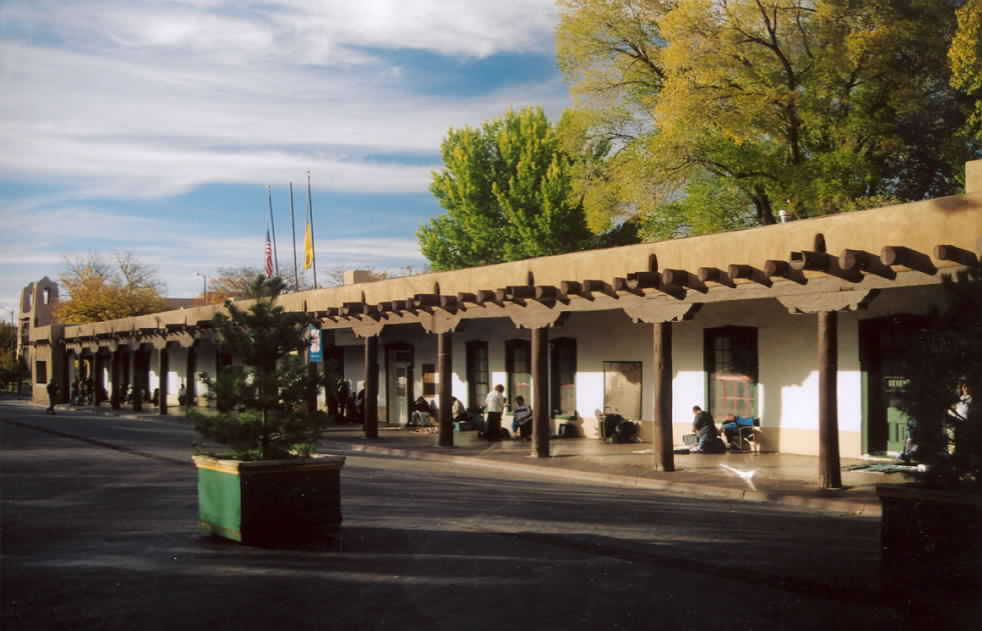
Palace of the Governors
We also went to the New Mexico Museum of History which was fascinating. It is in the old, original Palace of the Governors that has been in that spot for 400 years! The Spanish colonists built much of the building and over the centuries different groups built over the site. They have excavated some of the building and left it observable from the main floor of the building.
Originally constructed in the early 17th century as Spain's seat of government for what is today the American Southwest, the Palace of the Governors chronicles the history of Santa Fe, as well as New Mexico and the region. This adobe structure, now the state's history museum, was designated a Registered National Historic Landmark in 1960 and an American Treasure in 1999.
This was also the site of the Pueblo rebellion against the Spanish colonists who treated them badly. Many of the Pueblo people harbored a latent hostility toward the Spanish, primarily due to their denigration and prohibition of the traditional religion. The traditional economies of the pueblos were likewise disrupted, the people doing forced labor on the properties of the colonists.Some Pueblo people may have been forced to labor in the mines of Mexico. However, the Spanish had also introduced new farming implements and provided some measure of security against Navajo and Apache raiding parties. As a result, they had lived in relative peace with the Spanish since the founding of the Northern New Mexico colony in 1598.
In the 1670s, drought swept the region, which caused famine among the Pueblo and provoked increased attacks from neighboring nomadic tribes—attacks against which Spanish soldiers were unable to defend. At the same time, European-introduced diseases were ravaging the natives, greatly decreasing their numbers. Unsatisfied with the protective powers of the Spanish crown and disenchanted with the Roman Catholic church it had brought along, the people turned to their old religions. This provoked a wave of repression on the part of missionaries. Fray Alonso de Posada (in NM 1656-1665) "forbade Kachina dances by the Pueblo Indians and ordered the missionaries to seize every mask, prayer stick, and effigy they could lay their hands on and burn them..... In matters regarding their religion, the Pueblos of the seventeenth Century were not that different from those of today. To give up their religion would have been like giving up life itself."
In 1675, Governor Juan Francisco Treviño ordered the arrest of forty-seven Pueblo medicine men and accused them of practicing witchcraft. Four medicine men were sentenced to death by hanging; three of those sentences were carried out, while the fourth prisoner committed suicide. The remaining men were publicly whipped and sentenced to prison. When this news reached the Pueblo leaders, they moved in force to Santa Fe where the prisoners were held. Because a large number of Spanish soldiers were away fighting the Apache, Governor Treviño released the prisoners. Among those released was an Indian named "Pope" (pronounced Po'Pay).
Following his release, Pope, along with a number of other Pueblo leaders planned and orchestrated the Pueblo Revolt. He plotted the revolt from Taos pueblo. Popé dispatched runners to all the Pueblos carrying knotted cords, the knots signifying the number of days remaining until the appointed day. Each morning the Pueblo leadership was to untie one knot from the cord, and when the last knot was untied, that would be the signal for them to rise against the Spaniards in unison.
The day for the attack had been fixed for August 11, 1680, but the Spaniards learned of the revolt after capturing two Tesuque Peublo youths entrusted with carrying the message to the pueblos. Popé then ordered the execution of the plot on August 10, before the uprising could be put down.
The attack was commenced by the Taos, and two other pueblo Indian communities in their respective pueblos. They killed twenty-one of the province's forty Franciscans, and three hundred and eighty Spaniards, including men, women, and children. Spanish settlers fled to Santa Fe, the only Spanish city, and Isleta Pueblo, one of the few Pueblos that did not participate in the rebellion.
Popé's insurgents besieged Santa Fe, surrounding the city and cutting off its water supply. New Mexico Governor Antonio de Otermín, barricaded in the Governor's Palace, called for a general retreat. On August 21 the remaining 3,000 Spanish settlers streamed out of the capital city and headed for El Paso del Norte. The Pueblo Indians acquired horses from the Spanish, thus allowing the further spread of horses to the Plains tribes. What history in this building!!We also saw an exhibit called “Wild at Heart” about Ernest Thompson Seton.. The exhibit traced how one wolf’s death led to a century of wildlife conservation.
This was a fascinating exhibit about the conversion of Ernest Thompson Seton from a hunter to a conservationist, author, artist, lecturer and co-founder of the Boy Scouts of America. Ernest Thompson Seton’s impact on America’s conservation movement was immeasurable but, today is largely forgotten. Seton also heavily influenced Lord Baton, the founder of Scouting. His notable books related to Scouting include The Birch Bark Roll and The Boy Scout Handbook. He is responsible for the strong influence of American Indian culture in the BSA. What an interesting man!
That evening we had dinner with our good friends Turza and Andy Shows who drove through from Colorado on their way back to Ramah NM where they live. They took us to La Fonda for drinks on the roof and dinner in their traditional New Mexican dining room to celebrate Jack’s birthday. That was a lovely evening, too.
Tuesday was our last full day in Santa Fe. We explored the galleries of Canyon Road, went to Casa Nova and found a few additional purchases we just had to have. We relaxed in the condo for the evening and packed up. We had to leave time on Wednesday to meet new friends for lunch in Albuquerque on our way home.
But to put life in perspective, we also learned that one of our dear friends, Al Wolf died. Two other friends are struggling with blood clots and tumors. The lessons for me from these losses and health issues are about taking care of ourselves and enjoying every minute we have on this beautiful earth.
We hope you are taking care of yourselves and enjoying every minute, as well!


No comments:
Post a Comment