
2007 SW travelog
July 15, 2007 Get your Kicks on Route 66!
Well, maybe route 93.
Jack and I have started out on our 3 week adventure through the wild west. Buffalo Bill and Calamity Jane will be some of the characters we expect to encounter as we travel NW across Arizona, through Nevada and Utah up to Jackson Hole, Wyoming. There we stop for a retreat I will conduct for clients. From there we visit Yellowstone National Park, Cody Wyoming (home of the Cody Rodeo and The Buffalo Bill Museum). Our next stop is Deadwood, where Calamity Jane is buried and visit Mt. Rushmore. We stop at Casper, Wyoming for more information on the history of the western migration en route to Boulder Colorado where my next bit of work will be found. From there we drive via Leadville on to Aspen for the Aspen Family Business Gathering. My computer routing system tells me that we will cover just over 3000 miles in that 3 week period.
 Joshua Tree
The first leg of our trip takes us through the old town of Wickenburg, Az. and through a forest of Joshua trees leading us NW towards Kingman, famous for mining of turquoise and gold. It is now a transit point to L.A., Las Vegas and is the heart of old Route 66: the first paved transcontinental road to connect the East with the West. We are now heading north from Kingman to Las Vegas, our first stop. The only delay we expect is around the Hoover Dam, just south of Las Vegas where (l) there is construction and (2) high security since 9/11. There has been a fear ever since that a terrorist might want to blow up the dam. Most of the desert we are passing through is very dry. We haven’t seen any creeks or rivers with water. The plains are broken with mountains rising up about 3-5000 miles above the floor around us. In addition to the Joshua trees, we have seen other drought-resistant plants like mesquite, Mormon tea, brittle bush and saguaro cactus.
Monday July 16, 2007 Sundance Utah
We did come to a stop about 10 miles before the Hoover Dam. It took us over an hour to get to a check point (and about 15 seconds to be waved on) and another 30 minutes of traffic around the dam: quite an engineering feat that was completed in 1935. They are now creating more challenging structures: new highways high above the dam across the canyon.
We arrived in Las Vegas around 4PM and found our way to the hotel, to dinner, to some gaming and to bed after a long day.
And today we went from the ridiculous to the sublime: the glitz and crowds of Las Vegas to the peaceful beauty of Sundance Resort in the forest above Provo, Utah.

As we past through the canyons and tunnels in the mountains and turned left off the highway, we turned onto highway 92 into Sundance and my stress level reduced immediately. We were surrounded by a beautiful forest of aspens, pines and many other varieties of trees with a stream coursing along the road over rocks and fallen branches. It had been over 100 degrees (F.) in Arizona, Nevada and as we hit middle Utah, it began to cool off. By tonight, it cooled off to a pleasant 70+.
This is a resort created by Robert Redford (sigh). It is composed of many rustic wooden and stone buildings-most owned privately and rented as rooms or suites. The high end restaurant “The Tree Room” (with a tree that formerly grew through the ceiling) is rated one of the best restaurants in Utah.
 Sundance
Redford has created a community of artists here and has many cultural events here as well. They are very conservation conscious here and Redford donated much of the land via a conservation easement to preserve these beautiful mountains.
> >"
>"
>
>" Our drive this morning took us through Nevada which was flat and dry; (“the Great Basin”) then through the north-west corner of Arizona with magnificent canyons and rock formations (we were just north west of the Grand Canyon) and through southern Utah which began climbing almost as soon as we entered the state, and began showing us the beauty of Zion National Park. The first town we past in Utah was St. George, an early Mormon settlement. We could see the Mormon Spires in the distance as we drove through. St. George was founded as a cotton mission in the 1850s under the direction of Brigham Young, the President of The Church of Jesus Christ of Latter-day Saints (the Mormons or LDS Church)— part of a greater church effort to become self-sufficient. While the early settlers did manage to grow cotton, it was never produced at competitive market rates; consequently, cotton farming was eventually abandoned when the civil war was over and cotton was available in the South again.
The area is also for iron ore, as well.
We began seeing farmland in the valleys we traversed, with rock walls or mountains growing around us. We had checked the news because there were huge fires in Utah burning hundreds of thousands of acres; much of which was along highway 15 where we would spend most of the day. The highway dept assured us that the fires were contained and the road was open. We began thinking that fires were preceding us wherever we went this summer: Catalina, Maui and now Utah! We saw some of the burned ground and trees and smoke not far off the highway. Very sad.
Finally, we reached Provo, Utah, home of Brigham Young University and the foot of the Wasatch mountains where we would find Sundance. I last visited Provo in 1986 when the Family Firm Institute had its first conference here and I met a number of my long term colleagues.
The area is also for iron ore, as well.
We began seeing farmland in the valleys we traversed, with rock walls or mountains growing around us. We had checked the news because there were huge fires in Utah burning hundreds of thousands of acres; much of which was along highway 15 where we would spend most of the day. The highway dept assured us that the fires were contained and the road was open. We began thinking that fires were preceding us wherever we went this summer: Catalina, Maui and now Utah! We saw some of the burned ground and trees and smoke not far off the highway. Very sad.
Finally, we reached Provo, Utah, home of Brigham Young University and the foot of the Wasatch mountains where we would find Sundance. I last visited Provo in 1986 when the Family Firm Institute had its first conference here and I met a number of my long term colleagues.
Tomorrow we go on to Jackson Hole, Wyoming.
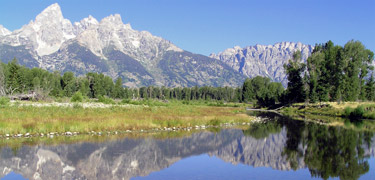 Jackson Hole/Grand Tetons
Wednesday, July 18, Jackson Hole, Wyoming
Here we are in a valley surrounded by the Grand Teton Mountains. Spectacular. On the way here, we had an incredible ride, with the top down in the car, driving through canyons, forests and rolling hills. The weather was perfect with blue skies, high 70 degree temps and the breeze flowing with us most of the time. One of the highpoints was the Logan Canyon Highway (part of Route 89). This is comparable in fun and beauty to highway 12 in eastern Utah.
The road goes past the rocky river shore to tumbling waterfalls. Birch and willow trees create a shady introduction to the brilliant turquoise waters of Bear lake. We drove along Bear Lake, (in Utah and Idaho) and saw signs of the earliest Mormon expeditions west. In Paris, Idaho, we saw a Tabernacle built by one of the sons of Brigham Young. The lake on our right was complemented by the farms on our left. A lovely valley with hills reaching toward 6000 feet high beyond. At one point we took a double take when we saw cows being herded by two cowboys on horseback with a dog following behind. Could have been right out of a western movie. Oh wait! We are in the west!! Then we stopped at a Museum specializing in the westward migration and travels on the Oregon trail. From there, (Montpelier Wyoming) we headed into the mountains to Jackson.
In 1803, Thomas Jefferson organized the Lewis and Clark Corps of Discovery expedition to explore the unknown territory of the Louisiana Purchase . The expedition traveled up the Missouri River and crossed the Rocky Mountains far to the north of Wyoming , in Montana , on their trip to the Pacific Ocean . During the return journey in 1806, John Colter, one of the members of the Expedition, headed back into the mountains to scout for a fur trading company. On a trip to the Crow, Colter probably entered Jackson Hole in the winter of 1807-8. He traveled into Crow territory to persuade them to trap for valuable beaver pelts, which were used for the fashionable hats of the era.
 ">
">
Snake River
When other trappers followed Colter's example, Jackson Hole became one of the prime areas of interest. Most of the famous mountain men that trapped in the West in the early 1800's traveled the trails that crossed the valley: Jim Bridger, Jedediah Smith, William Sublette, and David Jackson were among them. They traveled through the area going to and from the annual summer Rendezvous where they traded their beaver pelts and celebrated a successful trapping season. But it was David Jackson who gave his name to the valley when he supposedly spent the winter of 1829 on the shores of Jackson Lake . For the mountain men, a "hole" indicated a high valley that was surrounded by mountains, and William Sublette, who was Jackson 's partner in an early fur company, referred to the mountain valley along the Snake River as Jackson 's Hole. The mountain men were responsible for many, if not most, of the names in the valley. It was French Canadian trappers who named the three prominent peaks of the area "Les Trois Tetons," or the three breasts: Grand Teton , Middle Teton, and South Teton. The mountains extend above 13,000 feet tall!
The road goes past the rocky river shore to tumbling waterfalls. Birch and willow trees create a shady introduction to the brilliant turquoise waters of Bear lake. We drove along Bear Lake, (in Utah and Idaho) and saw signs of the earliest Mormon expeditions west. In Paris, Idaho, we saw a Tabernacle built by one of the sons of Brigham Young. The lake on our right was complemented by the farms on our left. A lovely valley with hills reaching toward 6000 feet high beyond. At one point we took a double take when we saw cows being herded by two cowboys on horseback with a dog following behind. Could have been right out of a western movie. Oh wait! We are in the west!! Then we stopped at a Museum specializing in the westward migration and travels on the Oregon trail. From there, (Montpelier Wyoming) we headed into the mountains to Jackson.
In 1803, Thomas Jefferson organized the Lewis and Clark Corps of Discovery expedition to explore the unknown territory of the Louisiana Purchase . The expedition traveled up the Missouri River and crossed the Rocky Mountains far to the north of Wyoming , in Montana , on their trip to the Pacific Ocean . During the return journey in 1806, John Colter, one of the members of the Expedition, headed back into the mountains to scout for a fur trading company. On a trip to the Crow, Colter probably entered Jackson Hole in the winter of 1807-8. He traveled into Crow territory to persuade them to trap for valuable beaver pelts, which were used for the fashionable hats of the era.
">Snake River
When other trappers followed Colter's example, Jackson Hole became one of the prime areas of interest. Most of the famous mountain men that trapped in the West in the early 1800's traveled the trails that crossed the valley: Jim Bridger, Jedediah Smith, William Sublette, and David Jackson were among them. They traveled through the area going to and from the annual summer Rendezvous where they traded their beaver pelts and celebrated a successful trapping season. But it was David Jackson who gave his name to the valley when he supposedly spent the winter of 1829 on the shores of Jackson Lake . For the mountain men, a "hole" indicated a high valley that was surrounded by mountains, and William Sublette, who was Jackson 's partner in an early fur company, referred to the mountain valley along the Snake River as Jackson 's Hole. The mountain men were responsible for many, if not most, of the names in the valley. It was French Canadian trappers who named the three prominent peaks of the area "Les Trois Tetons," or the three breasts: Grand Teton , Middle Teton, and South Teton. The mountains extend above 13,000 feet tall!
Now, Jackson is home to wealthy families (average price of homes on the market: $3 Million) and people enjoying the art, the outdoors and the western atmosphere. In fact, there is an art show (outdoors) happening this weekend and our good friends Andy and Turza Shows are here for the show. We will have dinner with them this evening. The rest of our time here is work (for me) and exploring for Jack.


No comments:
Post a Comment